
U.S. President Donald J. Trump, on Saturday, January 3, announced the capture of Venezuelan President Nicolás Maduro following an overnight joint military operation in Caracas.
Speaking at a news conference from his Mar-a-Lago residence in Palm Beach, Florida, Trump described the raid as a high-risk extraction carried out against what he called a heavily fortified target in the heart of Venezuela’s capital.
According to the U.S. President, the operation resulted in the arrest of Maduro and his wife, Cilia Flores de Maduro. Trump said the pair will face criminal proceedings in the United States stemming from a 2020 Department of Justice indictment that includes charges of narco-terrorism and drug trafficking.
While the detention of a sitting foreign president is rare and controversial, Maduro’s case is not without historical precedent. On a handful of consequential occasions, the United States has directly detained or removed sitting presidents or de facto heads of state abroad, actions that have often sparked lasting legal, diplomatic and sovereignty debates.
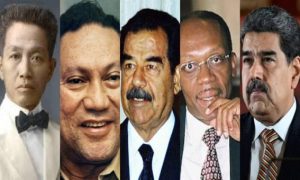
Here are notable foreign leaders who have been detained by the United States.
1. 1901 — Emilio Aguinaldo (Philippines)
During the Philippine–American War, U.S. forces conducted a covert operation to capture Emilio Aguinaldo — leader of the Filipino independence movement and head of a rival government. Although not a president in today’s sense, Aguinaldo’s detention effectively broke organized resistance and highlighted America’s expanding imperial reach at the start of the 20th century.
His capture remains a defining moment in early U.S. colonial history
2. 1990 — Manuel Noriega (Panama)
Once a CIA asset turned adversary, Panama’s military ruler Manuel Noriega was seized during Operation Just Cause, the U.S. invasion of Panama in 1989–1990. After his surrender, Noriega was flown to the United States, tried in a federal court on drug trafficking charges and sentenced to prison.
His case stands as perhaps the clearest example of the U.S. treating a foreign head of state as a criminal defendant within its own legal system.
3. 2003 — Saddam Hussein (Iraq)
After the U.S.-led invasion of Iraq, Saddam Hussein was found hiding near Tikrit in December 2003. His capture marked a symbolic end to the Ba’athist regime.
Following his arrest, Saddam was transferred to Iraqi authorities, tried before an Iraqi court for crimes against humanity and executed in 2006.
This remains one of the most legally formalised cases of a foreign leader detained after U.S. military engagement.
4. 2004 — Jean-Bertrand Aristide (Haiti)
The removal of Haitian President Jean-Bertrand Aristide remains one of the most disputed U.S. interventions of the modern era.
In the midst of an armed uprising, U.S. forces escorted Aristide onto a plane and flew him out of Haiti.
Washington described the move as a protective evacuation amid chaos, while Aristide later denounced it as a forcible removal, calling it a “kidnapping.”
Debate endures over whether he was “captured,” but the U.S. undeniably controlled his departure.
5. 2026 — Nicolás Maduro (Venezuela)
In a stunning and highly controversial military operation on January 3, 2026, U.S. forces captured Venezuelan President Nicolás Maduro in Caracas and transported him to New York to face criminal charges, including narco-terrorism and drug trafficking.
Maduro and his wife, Cilia Flores, appeared in federal court on January 5 and entered not guilty pleas amid debate over the legality of the operation and claims of presidential immunity.
The Trump administration argued the action was justified by longstanding indictments and a global narcotics threat, but critics say it violates international law and sovereign norms.
Be the first to comment