
Patients stranded across Nigeria as health workers’ strike enters third month
Despite a federal government directive enforcing a “no work, no pay” policy, JOHESU has insisted that the strike will continue until its demands are met.
by Aisha Yusufu,Anas January 16, 2026
For more than two months, public hospitals across Nigeria have struggled to function amid an indefinite strike by the Joint Health Sector Unions (JOHESU), leaving patients stranded, essential services paralysed, and doctors and nurses operating with little institutional support.
Visits by PREMIUM TIMES reporters to health facilities in Abuja, Kano, Kaduna, Akwa Ibom, and Lagos during the week revealed a health system operating on skeletal services, with laboratories, pharmacies, medical records, and diagnostic units shut.
The strike, which began on 15 November, stems from a long-standing dispute with the federal government over delayed salary adjustments under the Consolidated Health Salary Structure (CONHESS) and what the union describes as years of neglect and discriminatory treatment compared to doctors.
Despite a federal government directive enforcing a “no work, no pay” policy and instructing hospitals to sustain essential services, JOHESU has insisted that the strike will continue until its demands are met.
The Trade Union Congress (TUC) also intervened on Wednesday, issuing a seven-day ultimatum to the federal government to withdraw the ‘no work, no pay’ directive, noting that the policy could escalate the dispute while negotiations are still ongoing.
Locked doors, deserted wards in Abuja
At the National Hospital, Abuja, the impact of the strike was evident. The main entrance leading to the emergency unit was locked, with a notice informing patients that full treatment would not be available due to the strike.
Access to the unit was only possible through a back entrance. The Records and Visits Department, which serves as the first point of contact for most patients, was also shut. A security officer explained that record officers now resume briefly in the morning and leave at the same time, also in the morning.
“If you come after 11 or 12 noon, you won’t meet anyone there,” he said. “Patients are usually directed straight to the General Out-Patient Department (GOPD).”
Checks by PREMIUM TIMES showed that the National Health Insurance Scheme (NHIS) unit was also closed, leaving insured patients unable to access care.
“Without NHIS, I can’t afford to pay from my pocket,” said a patient who declined to be named.
The pharmacy serving the private and inpatient wings was partially open, but service windows were shut. Only one staff member was seen inside and declined to comment.
Another patient, who identified as Israel, expressed frustration over the situation.“The staff may have their reasons, but it’s the poor that are suffering,” he said. “If you don’t have money for a private hospital, you are stuck.”
At Maitama District Hospital, usually bustling outpatient corridors were almost empty at 10 a.m. on Tuesday. Seats lining the corridors were empty, with no queues, consultations or visible signs of routine medical services across several departments.
“Doctors are around, but without other support staff, only a few patients can be attended to,” a health worker said, requesting anonymity.
At Asokoro District Hospital, some units were observed to be operational, while others were shut. The maternal and child care units, eye clinics and immunisation services were operational, but the laboratory was closed. At the GOPD, a patient said she had waited nearly an hour for doctors who had yet to arrive.
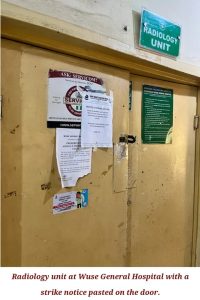
At Wuse District Hospital, skeletal services were observed across the facility. Notices announcing the strike were pasted at key service points, including the pharmacy and radiology units.
“Please be informed that the Joint Health Sector Union of the FCTA hospitals is on indefinite strike action,” one notice read.
Strain on Akwa Ibom hospital
In Akwa Ibom State, services remained crippled at the University of Uyo Teaching Hospital as the strike led to the shutdown of key departments.
When PREMIUM TIMES visited on Thursday morning, only skeletal services were available. Doctors and nurses attended to patients, but laboratories, radiology units, pharmacies, health records, physiotherapy and nutrition departments were shut.
Patients were forced to seek these services outside the hospital at higher costs. A hospital staff member, who pleaded anonymity, described the situation as “a sad era in the healthcare sector.”
“Our people are bearing the brunt of a strike caused by the government’s failure to implement agreements reached as far back as 2014,” the staff member said.
The source explained that many patients were unable to access their medical records and were therefore assessed as first-time patients.
“After seeing the doctor, they leave the hospital to access services outside at exorbitant rates and still return,” the source said, warning that maternal and infant mortality could rise.
Three patient relatives who spoke with our reporter lamented the cost of transporting their relatives outside the hospital to access services affected by the strike.
Comfort Akpan, a relative, said her mother paid for prescription glasses before the strike but had not received them. “For two months now, my mother has not gotten her glasses because optometrists are not available,” she said.
Kaduna hospitals run on skeletal services
Skeletal services were also maintained at the Ahmadu Bello University Teaching Hospital (ABUTH), Shika-Zaria. The chairman of JOHESU at the hospital, Tofik Olayinka, said members could not completely shut down services but were offering minimal support.
“All we are asking for is fairness and equity,” Mr Olayinka said. “CONMESS has been adjusted three times, while CONHESS has not been adjusted for years.”
Mr Olayinka, who also serves as secretary of JOHESU in Kaduna State, said the union had struggled with the government since 2014 without success.
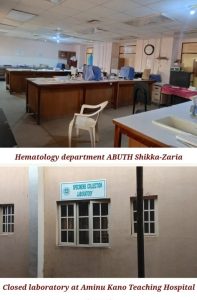
At the hospital’s haematology department, a few workers were seen attending to emergencies. The laboratory and pharmacy units were closed, while the blood bank remained operational.
A consultant at the Medical Emergency Unit stated that health workers, particularly doctors and nurses, are working fully and attending to patients.
Long waits in Kano
At Aminu Kano Teaching Hospital (AKTH), services were visibly disrupted. On Wednesday, PREMIUM TIMES observed that nurses were present in the early hours of the day but later left, leaving doctors to attend to patients alone.
“We are doing both our work and theirs,” a doctor said. “We can’t attend to as many patients as before.” A woman said she managed to get her mother treated only because she knew a doctor.
An NHIS staff member said JOHESU leaders paraded the hospital to enforce compliance with the strike. “They were very serious,” he said. “Anyone who was supposed to be on strike but came to work was sent away.”
Patients and their relatives at the Accident and Emergency unit expressed concern about the situation. A father, Zulhairu Alhaji-Malam, said he spent an entire day trying to secure a bed for his daughter, who needed a blood transfusion.
“They keep sending me from one department to another. Even paying for services has become an insurmountable hurdle, let alone accessing the actual medical treatment my daughter needs,” he said.
The impact of the strike is equally visible at the National Orthopaedic Hospital, Dala-Kano. One of JOHESU’s members in the state, Shehu Adamu, said the strike had gained momentum despite the government’s threats.
“The ‘no work, no pay’ policy has strengthened our resolve because we believe this struggle is ultimately for the long-term benefit of health workers, the patients, and the government itself,” Mr Adamu said.
Overstretched hospitals in Lagos
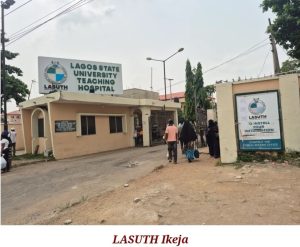
At the Lagos State University Teaching Hospital (LASUTH), Ikeja, the medical emergency unit was overwhelmed. The number of patients far exceeded the available doctors and nurses on duty.
Elizabeth Bayo, a relative of one of the patients receiving emergency care, said the strike is putting pressure on the available doctors and patients.“The doctors and nurses are available, but the strike is really felt,” she said.
“There are fewer people working, yet patients keep coming in. You can see how overwhelmed they are.”
A pregnant woman receiving antenatal care, who identified herself simply as Zainab, said patients had been asked to improvise by using exercise books to record their details.
“For weeks now, we have been told to buy exercise books and write our names there,” she said. “That is what we now take to the doctors. The e-system and other records are on hold.”
She added that the process had been stressful, as patients often had to search through several books to locate their records. “My next appointment is in February. I hope they resume before then,” she said.
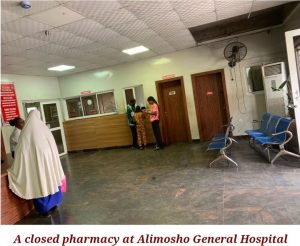
At Alimosho General Hospital, pharmacies and laboratories were shut. Patients were directed outside the hospital to purchase drugs. “For over one month now, I have been buying my drugs outside,” said Mummy David, an elderly patient.
Why the strike persists
The strike stems from a long-running dispute over salary adjustments and welfare conditions. JOHESU argues that while doctors under CONMESS have received multiple salary reviews, non-doctor health workers under CONHESS have been neglected.
In November 2025, the union issued a 15-day ultimatum, which expired without action, prompting the nationwide strike on 15 November.
Speaking to PREMIUM TIMES, JOHESU National Chairman Kabiru Minjibir said the union had a single core demand: the adjustment of CONHESS, the salary structure.
Mr Minjibir explained that the unions have been agitating for the adjustment for the past 12 years, arguing that while medical doctors benefit from the CONMESS, non-doctor health workers have been left behind.
He said the strike would be suspended if the government puts the salary adjustment in a circular, issues an implementation table and releases a payment plan for arrears.
Despite the “no work, no pay” directive, he said members voted to continue the strike.
In Lagos, JOHESU Secretary Adegboyega Kabiawu said members make up about 85 per cent of the health workforce.
He said local demands for health care workers in Lagos include the domestication of consultancy pharmacy, establishment of a medical laboratory services directorate, equitable allowances and improved staff transportation.
Be the first to comment