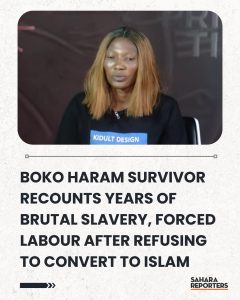
Speaking in an interview on Arise Television on Wednesday, Akilawus said she consistently refused to renounce her Christian faith, a decision that, according to her, condemned her to slavery under what the captors described as their “law.”
“They wanted me to convert to Islam and I said no,” she recounted. “They told us that if we did not convert, we would become their slaves.”
She explained that refusing conversion meant being subjected to forced domestic labour, including fetching water, carrying firewood and performing household chores for members of the camp.
“I am a Christian, and they wanted us to convert to Islam. If we refused, we became their slaves. They told us that if we didn’t want to be slaves, we should become Muslims. But if we remained Christians, then we would be their slaves,” she said.
“We would do house chores and other things for them. We carried firewood, fetched water, and did all sorts of work.”
According to her, the pressure to convert was relentless and lasted for several months.
“It wasn’t only once. They normally came to our place and said they were preaching to us, that they wanted us to become better people in life. They told us that if we accepted their religion, life would be better for us,” she said.
She said she resisted the pressure for nine months, alongside other captives who also refused to convert. Eventually, she said, the captors decided to separate them and distribute them to different homes to serve as slaves.
“We were in that place for nine months before they started separating us. Since we were not Islamised, they said they would separate each and every one of us and take us to their houses to become their slaves,” she said.
Recounting her first escape attempt, the survivor said she and another captive, identified as Auntie Jumai, tried to flee just days after arriving at the camp.
The two women reportedly trekked through the night, navigating bush paths and water routes. However, their escape was cut short the following morning when they unknowingly walked into a settlement.
She narrated, “From the time we arrived; Monday, Tuesday, Wednesday, Thursday, Friday, on Saturday night, around 7 p.m., Auntie Jumai, whom I was with from the place where we were captured, and I tried to escape.
“So, we escaped that Saturday night. We walked throughout the night. In the morning, when we heard a baby crying, we didn’t know there were families and children living there. When we heard the baby’s voice, we thought it was those armed men who used to raid cows. So, we greeted them with ‘Salam Alaikum’ and entered.”
“When we entered, the people came out and saw us. They started shouting because our dressing was different from theirs. They were shouting, asking, ‘Who are these people?’ Someone said her husband was not around.
“When we realised, we knew it was them again. They captured us and took us back. This first time, they didn’t chain us, but they beat us severely. The place we had trekked to was very far. From there, they beat us all the way back to the camp we had escaped from. It was at night, through the bush and through water.”
She said her determination to escape never wavered, despite repeated punishment.
“With God, all things are possible. We prayed, and God had mercy on us. I tried to escape once, twice, three times, four times. This was the fifth time. Whenever they caught me, they tied my legs with chains; motorcycle chains. I told myself I would keep trying until I succeeded,” she said.
“We had heard that escape was possible if you met the right people, but money was required,” she added.
“We had to pay ₦250,000. We sold some of their belongings and some things we bought ourselves. Sometimes they gave us small amounts of money, and we saved it.”
SaharaReporters
She said their unfamiliar dressing immediately raised suspicion, leading to their recapture.

Copyright © 2025 | Website Design by Powerofnaija
Be the first to comment